
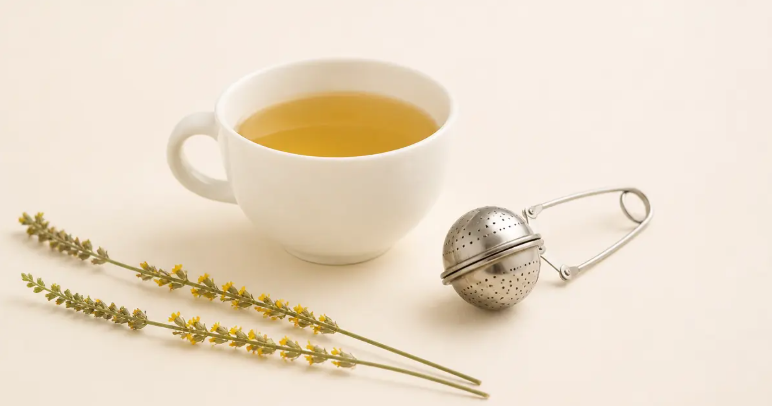
Learning how to brew agrimony tea without bitterness starts with four variables: the amount of herb, cut size, water volume, and steeping time. Agrimony has a dry, mildly bitter character, but the cup should not feel aggressively harsh. This guide gives you a repeatable starting method and shows how to correct a brew that tastes too bitter or puckering.
HerbEra separates the problem into measurable brewing variables instead of trying to hide an over-extracted cup with sweeteners. Change one variable at a time. You will quickly find the combination that suits your particular batch of herb.
This is a preparation guide, not a recommendation for a specific intake. Follow the directions on your product when they differ from the general brewing method below.
What is the simplest way to brew smooth agrimony tea?
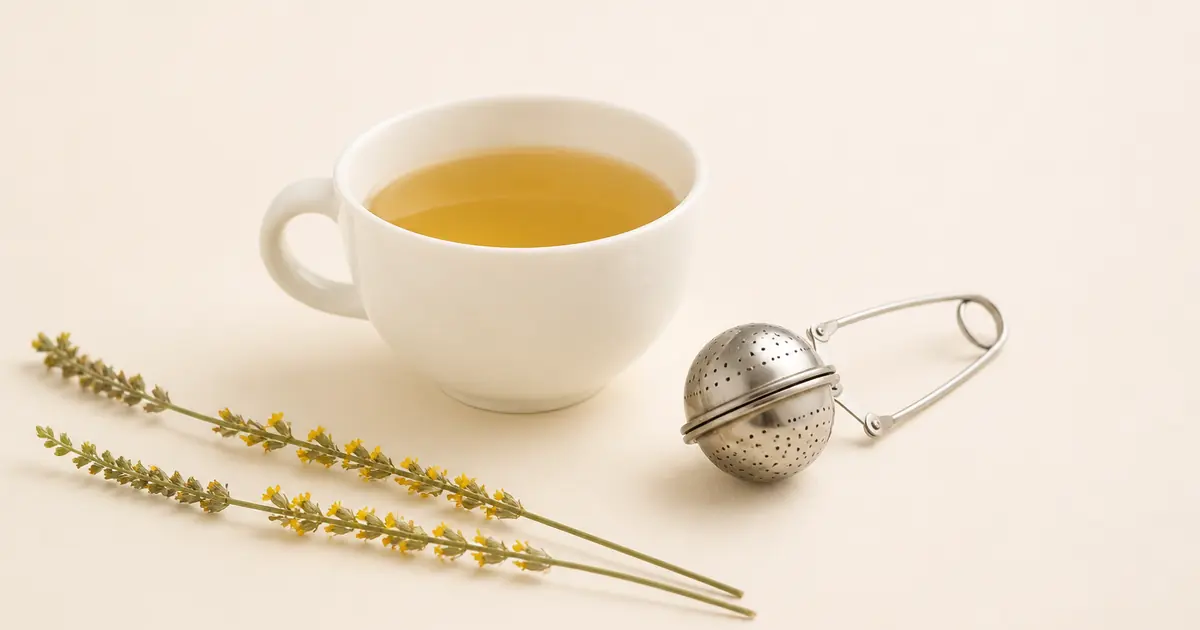
Use a modest amount of cut herb, freshly boiled water, and a five-minute covered infusion. Strain the tea as soon as the timer ends. If the flavor remains too intense, dilute the finished cup before changing several brewing variables at once.
A practical starting method
- Weigh 1.5 g of cut agrimony herb.
- Place it in a cup, infuser, or teapot.
- Add 250 ml of freshly boiled water.
- Cover the vessel to limit heat and aroma loss.
- Steep for five minutes.
- Remove the herb and let the tea cool slightly.
- Taste it before adding honey, sugar, lemon, or another herb.
The European agrimony monograph describes 1.5-4 g of comminuted herb in 250 ml of boiling water. Starting at the lower end creates a useful tasting baseline. It does not mean that every loose herb or tea bag has the same density, cut, or flavor profile.
A kitchen scale gives you a more consistent result than a teaspoon. A spoonful of coarse flowering tops may weigh much less than the same spoon filled with fine particles.
Why does agrimony tea become bitter or astringent?
Excessive extraction is the usual cause. More herb, smaller particles, less water, hotter water, and longer contact time can all increase the amount of water-soluble material in the cup.
Bitterness and astringency are different sensations
Bitterness is a basic taste detected on the tongue. Astringency is the dry, rough, or puckering sensation that develops across the mouth. People often describe both sensations simply as bitterness.
Agrimony contains tannins and other polyphenolic compounds. Tannins can contribute to its characteristic dry mouthfeel. A strongly puckering cup may therefore reflect a high herb-to-water ratio, fine material, or an unnecessarily long infusion.
The raw material changes the result
Two packages labeled agrimony can brew differently. The species, plant part, harvest, drying method, storage conditions, and particle distribution can affect color and taste. Powder and fine dust expose more surface area to water than intact leaves and flowering stem pieces.
Do not assume that a method developed for one package will produce an identical cup from another. Reset your timer and ratio when you open a new batch.
Which brewing variable should you change first?
Shorten the steeping time first. It is easy to measure and keeps the ingredient and water volume unchanged. If that adjustment is insufficient, use less herb or add more water.
The working preference at HerbEra is to shorten contact time before changing water temperature, since package directions may require boiling water. Freshly boiled water is commonly specified for herbal infusions and also matters when preparing raw plant material.
| Variable | What increases extraction | Possible flavor result | Best first adjustment |
|---|---|---|---|
| Steeping time | Longer contact with water | Deeper flavor and more dryness | Reduce the next infusion by one minute |
| Herb amount | More herb per cup | Concentrated, potentially harsh cup | Reduce the measured weight |
| Water volume | Less water for the same herb weight | More concentrated flavor | Add 30-50 ml more water |
| Cut size | Fine particles and powder | Rapid extraction and sediment | Use a coarser cut or filter out dust |
| Temperature | Hotter water usually extracts faster | Fuller taste that may become harsh | Keep boiling water if required and shorten time |
| Agitation | Frequent stirring or squeezing | More material enters the infusion | Let the herb steep undisturbed |
How does cut size affect agrimony tea?
Fine agrimony usually extracts more quickly than coarse pieces because more plant surface touches the water. Tea bags may contain small particles or dust, while loose agrimony may contain larger sections of leaf, stem, and flowering top.
Coarse-cut agrimony
Coarse material tends to release flavor more gradually. Five minutes is a sensible first test. If the result tastes thin rather than balanced, extend the next infusion by one minute.
Fine-cut agrimony
Fine material can become dry or harsh before a coarse batch reaches the same color. Start checking the cup after three or four minutes. Strain it through a fine mesh so particles do not continue extracting in the drink.
Powdered agrimony
Powder is difficult to remove with a standard basket infuser. It may leave sediment and a rough mouthfeel that resembles astringency. Use a paper filter, fine cloth filter, or a product designed for suspension if the label specifically calls for that preparation.
Should you use cooler water to reduce bitterness?
Not as the first adjustment. A lower temperature can change extraction, but raw herbal tea packages often instruct the user to add boiling water. Follow those directions unless the manufacturer explicitly provides another method.
If the label permits a temperature range, you can compare freshly boiled water with slightly cooler water in otherwise identical cups. Keep the herb weight, water volume, and steeping time constant. This makes the temperature difference meaningful.
Do not use lukewarm water merely to correct an over-extracted recipe. A shorter infusion or a lower herb-to-water ratio is easier to control.
How can you fix agrimony tea that is already too bitter?
Remove the plant material immediately and dilute the tea with hot water. Dilution lowers the concentration without adding another flavor. Sweeteners can mask bitterness, but they do not remove the extracted compounds responsible for dryness.
| Problem | Likely cause | Immediate adjustment | Next-brew adjustment |
|---|---|---|---|
| Sharp bitter taste | Long steep or too much herb | Add hot water | Steep one or two minutes less |
| Dry, puckering finish | High extraction of tannin-rich material | Dilute and drink after slight cooling | Use less herb and strain earlier |
| Weak aroma but harsh mouthfeel | Old herb or excessive fine particles | Filter the cup again | Choose a fresher, coarser cut |
| Cloudy tea with sediment | Powder escaping the infuser | Pass it through a paper filter | Use finer filtration |
| Balanced when hot but harsh when cool | Flavor becomes easier to perceive as temperature falls | Add a small amount of hot water | Shorten the infusion slightly |
| Inconsistent cups | Spoon measurements or changing water volume | Record the current result | Use a scale and measured cup |
Sweetening and blending
A small amount of honey or sugar may soften the perceived bitterness. Lemon can shift the flavor toward acidity, but it does not remove astringency. Add these ingredients only after tasting the plain infusion, or you will not know whether your brewing adjustment worked.
A mild aromatic herb can change the overall profile, but it also creates a blend rather than plain agrimony tea. Check every ingredient separately if allergies, sensitivities, pregnancy, medication use, or other personal restrictions apply.
Can agrimony be steeped a second time?
Yes, but the second cup will not match the first. Some readily soluble material has already entered the initial infusion, so a second steep may taste lighter. The result depends on cut size, first-steep duration, and herb quality.
Re-steep the herb immediately with fresh boiling water if the product directions allow it. Do not store damp plant material for later. Taste the second infusion early rather than assuming that it needs a very long steep.
Repeated brewing is not a reliable way to compare quantities or label directions. Consider it a flavor experiment, not an exact conversion.
Agrimony Tea Brewing Checklist
Use this checklist when a cup tastes too bitter, dry, or inconsistent. Record the herb weight and steeping time so you can reproduce the result. Change only one item between tests.
Confirm the herb
Check that the package identifies agrimony and states the botanical species or plant material where possible.
Read the preparation directions
Follow the package instructions for water temperature, quantity, and intended preparation.
Measure by weight
Use a scale instead of estimating with a spoon. Different cut sizes occupy different volumes.
Measure the water
Start with 250 ml unless the package specifies another volume. An undersized cup produces a more concentrated infusion.
Set a timer
Begin with five minutes for cut herb. Check fine material sooner.
Cover the cup
Use a lid or small plate while the herb steeps. Keep the method consistent between batches.
Strain completely
Remove all plant material when the timer ends. Use a finer filter if dust remains in the cup.
Taste before adding anything
Let the tea cool slightly and evaluate bitterness and dryness separately. Dilute an over-extracted cup with hot water.
How should dry agrimony be stored?
Keep the herb in a closed container away from moisture, direct light, heat, and strong odors. Note the date when you open the package. Changes in aroma, color, or moisture can make brewing results less predictable.
Prepare the infusion fresh and remove the wet herb after steeping. Discard damp material that has been left standing for an extended period.
FAQ
How long should agrimony tea steep?
Start with five minutes. Reduce the time to three or four minutes for very fine material or an overly harsh batch.
Why does agrimony tea make my mouth feel dry?
That sensation is astringency. Agrimony contains tannins, and prolonged or concentrated extraction can make the dry mouthfeel more noticeable.
Should agrimony tea be made with boiling water?
Use boiling water when the package instructs you to do so. Shorten the steeping time before experimenting with a lower temperature.
Can I add more water after brewing?
Yes. Adding hot water is the simplest way to correct an infusion that tastes too concentrated.
Does honey remove agrimony bitterness?
No. Honey can mask bitterness, but it does not remove the compounds already extracted into the water.
Why is tea-bag agrimony more bitter than loose herb?
Tea bags often contain smaller particles. Their larger exposed surface area can produce faster extraction.
Can I simmer agrimony instead of steeping it?
Use the method stated on the label. Simmering creates a decoction and may produce a more concentrated, harsher flavor than a short infusion.
Can I reuse agrimony after the first steep?
You can try an immediate second infusion. Expect a different and often lighter taste, and do not save wet herb for later.
Glossary
Astringency
A dry, rough, or puckering sensation in the mouth.
Bitterness
A basic taste sensation that differs from physical dryness.
Comminuted herb
Plant material reduced to smaller pieces for preparation or processing.
Cut size
The average size of the plant pieces in loose herb or a tea bag.
Extraction
The movement of soluble plant constituents into the brewing water.
Infusion
A preparation made by pouring hot or boiling water over plant material and steeping it.
Herb-to-water ratio
The weight of dry herb used for a measured volume of water.
Steeping time
The period during which the plant material remains in contact with water.
Tannins
Plant polyphenols that can contribute to a dry, puckering mouthfeel.
Conclusion
To brew smoother agrimony tea, start with a measured amount, 250 ml of water, and a five-minute infusion. If the cup tastes harsh, strain earlier or use less herb before changing the temperature or adding other flavors.
Sources Used
- European Union Herbal Monograph on Agrimonia eupatoria L., herba – ema.europa.eu/en/documents/herbal-monograph/final-european-union-herbal-monograph-agrimonia-eupatoria-l-herba-first-version_en.pdf
- Assessment Report on Agrimonia eupatoria L., herba – ema.europa.eu/en/documents/herbal-report/final-assessment-report-agrimonia-eupatoria-l-herba-first-version_en.pdf
- Patient Leaflet Template for the Preparation of Herbal Teas – ema.europa.eu/system/files/documents/regulatory-procedural-guideline/wc500225537_en.pdf
- Influence of Steeping Conditions on Sensory Attributes of White and Green Teas – pubmed.ncbi.nlm.nih.gov/26017324
- Effects of Brewing Conditions on Phytochemical Composition and Sensory Quality – pubmed.ncbi.nlm.nih.gov/30100430